let’s learn about…
Keloids and Hypertrophic Scars
Keloid and Hypertrophic Scar Treatment in Layton, Utah
Introduction
Scars are a natural part of healing, but sometimes the healing process goes into overdrive. If you have a scar that has become raised, red, itchy, or painful, it is likely more than just a cosmetic annoyance—it is a medical condition.
At my clinic in Layton, I specialize in treating pathological scars (scars that behave abnormally). Whether you have a thickened surgical scar or a large keloid growing on an earlobe or chest, we have effective strategies to flatten them and stop the itch.
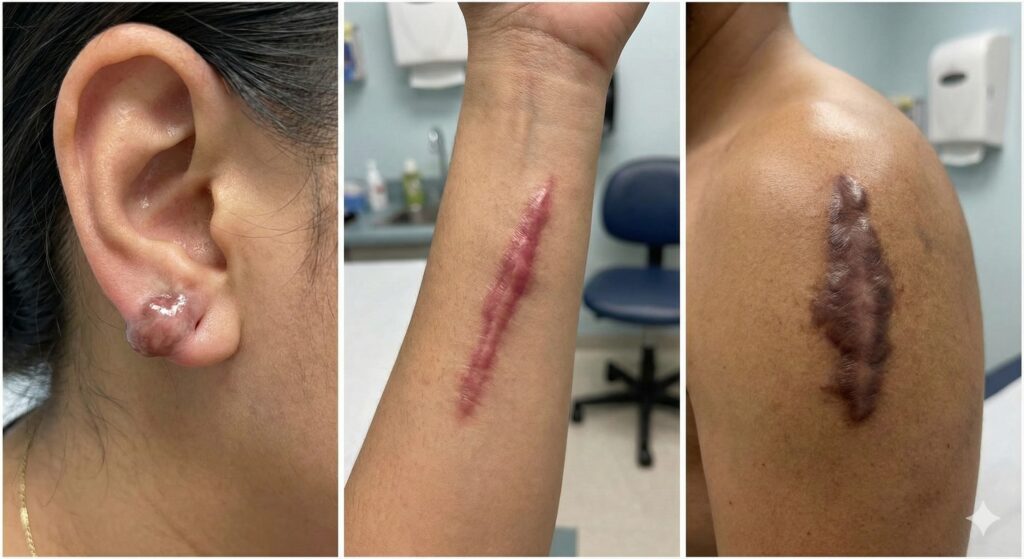
Know Your Scar: Hypertrophic vs. Keloid
The first step is determining which type of scar you have, as this dictates how aggressively we treat it.
- Hypertrophic Scars
- These are raised and red, but they stay within the boundaries of the original injury or incision. They often happen after surgeries (like C-sections) or deep burns. While they can be itchy, they generally stop growing on their own.
- Keloids
- Keloids are more aggressive. They grow beyond the boundaries of the original injury, invading the surrounding healthy skin. They can look like smooth, shiny, bulbous growths.
The Challenge: Keloids are notoriously stubborn. They have a high recurrence rate—meaning if you simply cut them off, they often grow back larger than before.
Common Locations: Earlobes (from piercings), chest, shoulders, and back.
Treatment Options
- First-Line Treatment: Intralesional Kenalog (ILK)
- For most raised scars, the most effective starting point is Intralesional Steroid Injections.
- The Procedure: We inject a concentrated steroid (Kenalog) directly into the hard scar tissue.
- The Goal: The medication turns off the inflammation and breaks down the tough collagen fibers. Over a series of monthly visits, the scar typically softens, flattens, and becomes less red. The itching usually stops after the very first injection.
- Advanced Options for Stubborn Keloids If you have a massive keloid or one that has failed steroid injections in the past, we need a more aggressive approach.
- Surgical Excision + Adjuvant Radiation Because keloids love to grow back after surgery, removing them requires a “one-two punch.”
- The Surgery: I perform a precise surgical excision in my office to remove the bulk of the keloid tissue.
- The Radiation: Immediately after the surgery (usually within 24 hours), I coordinate your care with a radiation oncology specialist. They administer a low dose of specialized radiation to the surgical site.
- Why Radiation? This prevents the scar cells from “turning back on.” This combination therapy has the highest success rate for permanently curing large keloids.
- Surgical Excision + Adjuvant Radiation Because keloids love to grow back after surgery, removing them requires a “one-two punch.”
Why See a Dermatologist?
Treating keloids requires a delicate balance. Treating too aggressively can cause skin indentations (atrophy), while treating too lightly results in recurrence. As a board-certified dermatologist, I understand the biology of scar tissue and can tailor the concentration of medication to your specific skin type.
Flatten Your Scars in Davis County
You don’t have to hide your scars under clothing or hair. Schedule a consultation to discuss your removal options.
Call 801-773-4840 to schedule a consultation
# Keloid removal Layton # Hypertrophic scar treatment Utah # Steroid injections for scars # Ear keloid surgery # Scar revision dermatologist Davis County # Intralesional kenalog (ILK) # Radiation for keloids # C-section scar treatment # Itchy scar relief # Kenalog 40 injection # Scar treatment Layton # Keloid treatment Davis County # Tanner Clinic Layton Parkway # Tanner Clinic Dermatology # Tanner Clinic Dermatologist