let’s learn about…
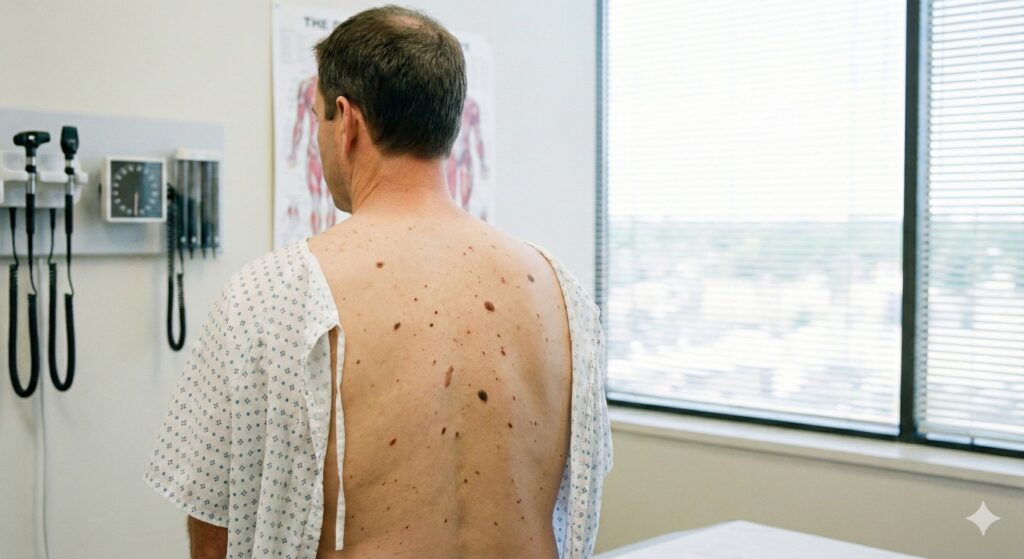
Moles (Nevi) & Skin Checks
Mole Checks and Skin Checks with Dermoscopy in Layton, Utah: Precision Skin Cancer Screening
Introduction
Living in Utah means living with the sun. As a result, almost everyone here has moles (medically known as Nevi). While most moles are harmless, telling the difference between a benign beauty mark and early melanoma can be difficult for the untrained eye.
At my clinic in Layton, I believe that a “quick glance” isn’t enough when it comes to your health. I utilize Dermoscopy—an advanced non-invasive imaging technique—during every skin exam to ensure we are seeing the full picture of your skin’s health.
The Dermoscopy Difference: Looking Deeper
In the past, doctors relied on the naked eye to judge if a mole looked “funny.” Today, we have a much better tool.
What is Dermoscopy? A dermatoscope is a specialized handheld device that combines high-powered magnification with polarized light.
The Problem: When you look at skin with the naked eye, light reflects off the surface (glare), preventing you from seeing what lies beneath.
The Solution: The dermatoscope cuts through that surface glare. This allows me to see the pigment network and structures located in the deeper layers of the epidermis and dermis.
Why the “Pigment Network” Matters
By visualizing this pigment network, I can identify subtle patterns that indicate if a mole is stable or starting to become chaotic (atypical, AKA dysplastic nevi).
Accuracy: Studies show that trained dermatologists using dermoscopy are significantly more accurate at diagnosing melanoma than those using the naked eye alone.
Peace of Mind: It helps us avoid unnecessary biopsies on harmless moles, while ensuring we catch the dangerous ones earlier than ever before.
When to Get a Mole Check
I recommend an annual full-body skin exam for most adults in Utah. However, you should come in sooner if you notice the ABCDEs of melanoma:
A – Asymmetry: One half doesn’t match the other.
B – Border: Edges are ragged, notched, or blurred.
C – Color: The color is not uniform (shades of brown, black, red, or blue).
D – Diameter: Larger than a pencil eraser (6mm), though some cancers can be smaller.
E – Evolving: The mole is changing in size, shape, or sensation (itching/bleeding).
- This one is the most important one. If you notice a mole that is changing and behaving different than the others (I call this the ‘Ugly Duckling Sign’), come in and we’ll see if it needs a biopsy.
Types of Moles We Manage
Common Nevi: Normal, stable moles.
Dysplastic Nevi (Atypical Moles): These look unusual (often larger or irregular) and carry a slightly higher risk of turning into melanoma. We monitor these closely with dermoscopy.
Congenital Nevi: Moles you were born with.
Mole Removal Options
If we find a suspicious mole, or if you simply have a raised mole that gets irritated by your clothing, removal is a simple in-office process.
Shave Removal: We numb the area and shave the mole flat. The tissue is always sent to the lab to confirm it is benign.
Surgical Excision: For deeper or more concerning moles, we may remove the entire lesion with stitches to ensure clear margins.
Schedule Your Skin Check in Davis County
Don’t rely on guesswork. Let me use the power of dermoscopy to give your skin a thorough, expert evaluation.
Call 801-773-4840 to schedule a consultation
# Mole check Layton # Skin check Layton # Skin cancer screening Davis County # Dermoscopy mole exam # Dysplastic nevus specialist # Dysplastic nevi # Mole removal Layton # Mole removal dermatologist Utah # Atypical moles # Full body skin exam # Melanoma detection # Changing mole # Pigment network analysis # Sunscreen # Medical dermatology Layton # Skin check in Davis County # Skin check in Weber County # Skin check in Morgan County # Dermatologist Layton # Dermatologist Utah # Dermatologist near me # Tanner Clinic Layton Parkway # Tanner Clinic Dermatology # Tanner Clinic Dermatologist # Dermatologist near me