let’s learn about…
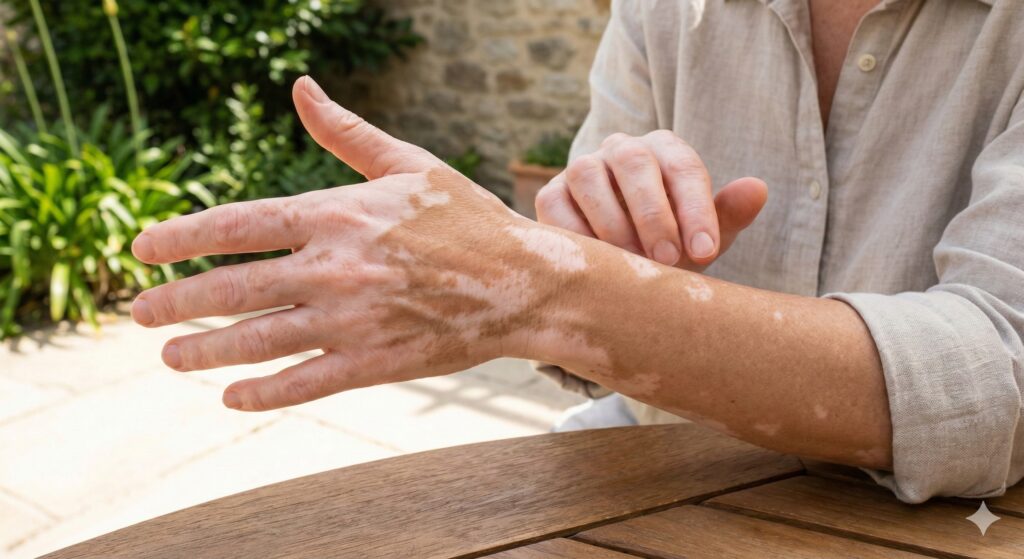
Vitiligo
Vitiligo Treatment in Layton, Utah: A New Era of Hope
Introduction
For many years, patients with Vitiligo were told, “There is nothing we can do.” They were told to just wear sunscreen or use makeup to cover the white patches.
Those days are over.
At my clinic in Layton, we treat Vitiligo as what it is: a medical autoimmune condition, not just a cosmetic nuisance. Science has advanced rapidly in the last few years, and we now have effective tools to help stabilize the condition and, in many cases, bring the color back.
What is Vitiligo?
Vitiligo occurs when your immune system gets confused and attacks your own melanocytes (the cells that make pigment). When these cells are destroyed, the skin loses its color and turns stark white.
It is Autoimmune: It is often related to thyroid issues or other immune conditions.
It is NOT Contagious: You cannot catch it from someone, and you cannot give it to anyone.
The “New” Treatment: JAK Inhibitors (Opzelura)
This is the biggest breakthrough in Vitiligo treatment in decades. Opzelura (Ruxolitinib) is a prescription cream that belongs to a class of medicines called JAK inhibitors.
How it works: It quiets the specific immune pathway that is hunting down your pigment cells. By turning off the attack, it allows your melanocytes to wake up and start producing color again.
The Results: Clinical studies have shown significant repigmentation, especially on the face and neck, with consistent use. As a board-certified dermatologist, I can determine if you are a candidate for this groundbreaking therapy.
Other Proven Treatments
While JAK inhibitors are the newest tool, we also use a combination of established therapies to get the best results:
- Topical Anti-Inflammatories We use prescription-strength corticosteroids and calcineurin inhibitors (like Tacrolimus) to calm the immune system. These are particularly helpful for small, new patches of vitiligo.
- Phototherapy (Light Therapy) Narrowband UVB light is one of the most effective ways to stimulate pigment across large areas of the body. Light therapy acts like a fertilizer for pigment cells, encouraging them to migrate back into the white patches from the hair follicles.
Realistic Expectations
Treating Vitiligo is a marathon, not a sprint. Pigment does not return overnight.
The Timeline: It often takes 3 to 6 months of consistent treatment to start seeing little dots of pigment (called “follicular repigmentation”) appearing inside the white patches.
Location Matters: The face and neck respond the fastest. Hands and feet are the most stubborn areas, but early treatment gives us the best chance.
Is It Actually Vitiligo?
Not all white spots are Vitiligo. Many patients come to me worried they have it, but actually have:
Tinea Versicolor: A common fungal infection that leaves white spots (easily curable).
Idiopathic Guttate Hypomelanosis: “Sun spots” caused by aging, not autoimmune disease.
Nevus Depigmentosus: A stable birthmark.
This is why seeing a specialist matters. We can differentiate these conditions instantly and save you unnecessary worry.
Reclaim Your Skin
If you have stopped treating your Vitiligo because you thought there were no options, I invite you to come in for a consultation. Let’s discuss what the new science can do for you.
Call 801-773-4840 to schedule a consultation
# Vitiligo # Vitiligo treatment Layton # Hypopigmentation # Opzelura prescriber Utah # White patches on skin doctor # Vitiligo specialist Davis County # Repigmentation therapy # Ruxolitinib cream # Excimer laser for vitiligo # Vinea versicolor vs vitiligo # Autoimmune skin disease # Light therapy for white spots # Medical dermatology Layton # Davis County # Vitiligo specialist Weber County # Vitiligo specialist Morgan County # Tanner Clinic Layton # Tanner Clinic Dermatologist # Tanner Clinic Dermatologist